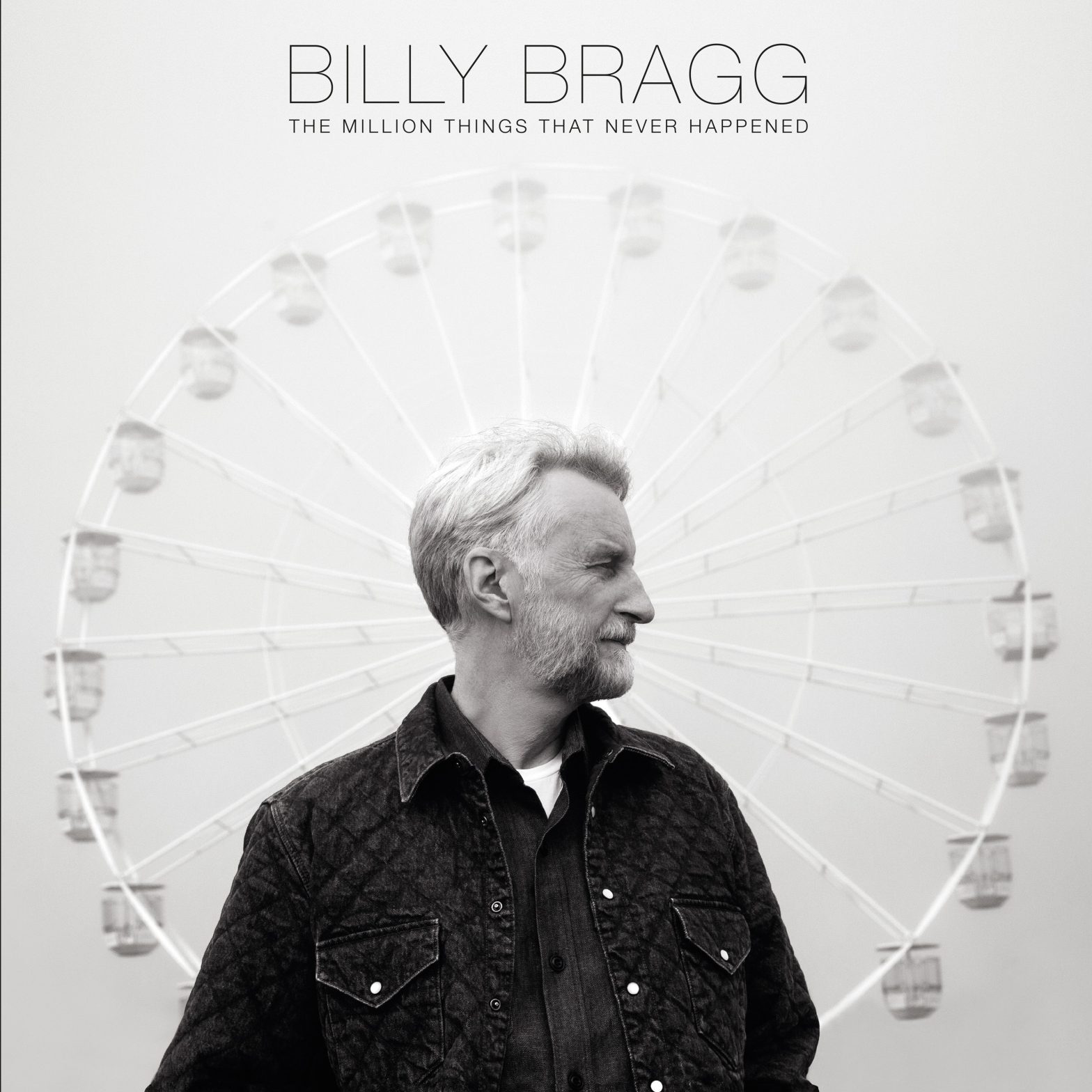
Billy Bragg

My workplace Crikey held a fascinating and invigorating interview with singer-songwriter and activist Billy Bragg last night. Bragg has written a handful of the songs that mean the most to me in all the world, and he everything you’d hope, talking with wit, optimism and clear-eyed scepticism about empathy, music, politics and going to Glastonbury with Boris Johnson:

The overriding theme of the evening, and the question Crikey readers put to Bragg the most, was this: how do you stay hopeful as a progressive in the face of rising authoritarianism, eroding working conditions and environmental catastrophe?

Bragg has a simple answer: empathy.

‘If you can’t love people other than your family, what use can you be as a socialist when our politics is based fundamentally on empathy?’

And if mixing pop and politics has any use, Bragg says it’s in bringing that empathy about.

‘When I come offstage, my activism is recharged and my cynicism is kicked to the kerb for a few hours, and my job is to make the audience feel the same,’ he said.

“Not because I’ve been brilliant or written great songs, but because people are looking around themselves and thinking, ‘I’m not alone in this. There are other people who care about this shit.’

You can read my write up here (paywall, sorry, but you can — and should! — get a free trial).

Meanwhile, smashing through my Billy Bragg playlist as I was writing the above, I was reminded of one of my favourite pieces of music writing. Greil Marcus on “Levi Stubb’s Tears” is one of those rare and wonderful pieces of criticism that’s every bit as rich and moving as the work it interrogates:

“Levi Stubbs’ Tears” is about a woman who listens to old Four Tops songs, maybe because their intensity lets her come to grips with her own feelings, maybe because the agony in Stubbs’ voice lets her take comfort, imagining that someone else hurts more than she does. She ran away from home, got married too young, her husband left her. One day he comes back and shoots her, but she lives. Save for a few ostentatiously poetic lines (“They stitched her back together and left her heart in pieces on the floor”), Bragg not only tells the story cleanly, he gets inside it, finds time for pauses: “Her husband was one of those blokes/Who seems to only laugh at his own jokes.” This is writing on the level of the best of Elvis Costello, and that’s as good as pop songwriting gets.

Pat Thomas Introduces Marijata 

Pat Thomas, The “Golden Voice of Africa” has had a career that spans more than 50 years. In that time, he’s turned his hand to a seemingly endless array of genres – Big Band, Reggae, Soul, Disco and Funk –  but he’s a true master of Highlife. Highlife originated in Thomas’ native Ghana in the 1920s when was still colonised by the British. It’s a genre that absorbed a series of foreign influences – jazz, calypso, the back and forth of Afro-Cuban music, not to mention electric guitars – melded them with traditional Akan melodies and then spat them back out into the world, gaining popularity, first in neighbouring countries and eventually the world.

Like so much African popular music of the era, it’s a portmanteau, a genre that wears its historical and political circumstances even more explicitly than most. 

Ghana’s first president Kwame Nkrumah became particularly influential in post-colonial thinking around art and culture, as African nations attempted to rediscover themselves in the second half of the 20th century. His argument was that it wasn’t enough to simply self-govern, Africans had to “decolonise the mind”, to mend the severed connections between people and their linguistic, artistic and musical histories. Colonisation, after all, steals more than just land and resources, or the dignity and freedom of a people.

As a genre, Highlife has an interesting place in that thinking — taking it’s name initially from its place as the upmarket good time music played in the exclusive clubs of the colonists, it spread into the streets and dance floors and became the perfect celebratory soundtrack to emancipation.

1976’s Pat Thomas Introduces Marijata is the first of two records he cut with the legendary funk trio Marijata, also from Ghana. Behind its wonderfully homemade looking orange cover, it’s probably the most straight up rock n soul record he ever did, but it’s still a distinctly Ghanaian product. It’s got those woozy Highlife horns and that reggae/ska guitar upstroke.

And thanks to Marijata’s razor sharp funk instincts – Kofi Addison on drums is on fire throughout – the album is relentless, yet light on its feet. 

Like the best Rock and Roll of the era, it’s loose-limbed to the point that it feels almost accidental, yet it never loses momentum.

The ebullient Thomas is still around, still remarkably consistent — The Guardian gave his most recent LP, Obiaa!, his second multi-generation collaboration with The Kwashibu Area Band, five stars. I’ll let you know if I agree with that estimation once my copy arrives, but the piece does make an important point: “Amid our penchant for curated archive compilations of far-flung genres, here is the living, breathing testament to a music that is very much still alive and being championed by those who have spent their lives perfecting its craft.”  

Highlife can tell you a lot about the history Ghana, and Pat Thomas can tell you a lot about the history of Highlife, and Pat Thomas introduces Marijata is as good a place as any to start.

Youth, Pop, and “Surf Music”

Youth came to me late. My indulgence of choice as a teen was weed, and being a perpetually bummed out stoner is about the oldest a 17-year-old can get. My early-to-mid-20s were spent in two back to back long term relationships and a perfectly fine office job that I happily steered into a dead end. I’d say it was 27, after a break-up and breakdown and the reshuffling of life that came with it that I started to feel young.

What I mean by feeling young is that energising sense of boundless possibility combined with a sadness, a sense  of the streets you won’t ever see if you take one turn instead of another, the figs that will rot at your feet once you’ve decided which you want, or at least, which you will have.

It wasn’t that my teens and twenties were boring or joyless, not at all, but I suspect I’m not the only person who could only access that specific lovely terror, what I understand to be the real thrill of youth, once a lot of it is gone.

I’ve been able to find only two pieces of writing about Surf Music by Paul Williams, an album I discovered through James Acaster’s latest stand up special and have been obsessed with ever since. Both struggle, as I have, to put their finger on what it is about it that they find so compelling. My best theory is that Surf Music, deliberately or otherwise, has an acute sense of that particular quality of youth, its vital, stinging, ephemeral and fleeting nature.

Williams is primarily a comedian, something that didn’t even occur to me until I’d listened to the album several times and googled him. Surf Music isn’t comedy album, and its humour mostly lands subtly. Part of this is down to Williams himself – he’s handsome and graceful, with that ability (which he shares with Odelay-era Beck and Pre-1965 Beatles) to cavort and goof without quite losing his cool. Check out the title track’s music video: Williams, decked out in early Beach Boys clobber, performs a long single take dance sequence – a mix of sixties style twists, toe taps and tail feathers with sassy Beyonce finger wags – and it all lands as eccentric but straight-faced.

Lyrically the album is littered with basketball and Bond film references, woven through a love story that is ambiguous about time frames (now/long ago) and status (intact/fractured). The lovely three-part harmony of “Number One” and later “Euroleague” deal with Anthony Bennett, considered one of the great flops in NBA history – a number one draft pick in 2013, plying his trade in Turkey by 2018, the cruelty and humiliation of sport standing in for the cruelty and humiliation of young love.

In case I’m making it all sound like some kind of arch art project, let me be clear: Surf Music is catchy and fun as hell. Musically it’s an immaculate pop confection, indulging in groggy auto tune, pulsing neon synths, drum machines, crooning falsetto and rap verses (“I ain’t 2 Chainz, I’m too shy, but if having a bad chick was a crime, I would do time”). On “Clouston Bridge”, when the outro suddenly surges into a melody that resembles “Blue Moon” run through a haunted computer, these aesthetic and thematic halves meet.

It’s not surf music in its sound, but it is in its heart – tales of lovesick sunburnt kids and their lost summer, and what that means to Williams (“when I hear that surf music, I hear that sound, it’s telling me ‘don’t let shit get you down’”).

Then there’s “Bond Themes from the Early 80s”. That savory, sad taste of the end of the night, trying to wring just a few more moments from the thrum of evening before the disjointed sleep and the hangover and Monday at work (“my ride is here but I ain’t in no rush”.) It will be familiar to anyone who has Uber’d home as dawn hauls itself over the horizon, a sleepy smile stuck to their lips, knowing it’ll never be quite like this again.

Lyrical Wax: Yvonne Fair The Bitch is Black

It Should Have Been Me“, were it not for Yvonne Fair, would qualify as maybe a second tier classic of the early soul era. It’s nevertheless a true classic of watching the one who promised they’d never leave walking down the aisle with someone else. I first became aware of it via the sublime Le Gateau Chocolat back in 2016. Chocolat did a colouful, upbeat version — which he envisaged as fabulous revenge, crashing of the wedding of the first boy he ever loved — before slowing down final chorus to a halting dirge. “It … should have been me…it … should have been me“. The effect was shattering.

Yvonne Fair’s version, the definitive one, never does that, but it never needs to. It is a genuine masterpiece of a certain tone that you hear all over pop music, but is never done better than by black women — the sound of depthless pain as a source of limitless strength.

So as the song fades out and we hear Fair howl “somebody call the police, that women up there is a doggone thief”, each word sounding like it’s taking her throat lining with it, it could be funny, too theatrical to take seriously, but it’s not. Compared to Fair, previous versions of the song by Gladys Knight and Kim Weston sound polite and utterly bloodless.

I had loved the song for years without, for whatever reason, ever looking into the singer any further. Then I saw The Bitch is Black — Fair’s only album — at a second hand book store late last year, and knew immediately I must have it.

I expected a fun little disco-infused trifle. As it turns out, the record is wall to wall molten fucking lava. The cover really ought to have tipped me off; Fair, throws us a “brace yourself” look, halfway between cool appraisal and amusement at our expense, a riding crop cocked into a C shape between her hands. This album is not fucking about.

The music is, accordingly, filthy, rough, occasionally slowing from its stomping funk to be sweet and tender.

Even when she slows it down, like on the slow build of “Stay a little bit longer” (Ghostface Killah’s idea of romance, so you know it’s good) there’s always the guttural element, that growl. Though the content is less explicit, the tone of lip-biting hunger isn’t a million miles from Betty Davis.

There are huge gaps and tantalising details in what we know Fair’s life; parlayed a single gig with the Chantels into a slot with the James Brown Revue the early sixties. She recorded “I found you” in 1962 — the song that Brown would eventually re-work into his proto-funk mega hit “I got you (I feel good)”.

She and Brown had a child together, and she later married Sammy Strain, one of the few people to be inducted into the Rock and Roll hall of Fame for two separate bands. Throughout the early 70s, having now signed to Motown, she opened for The Temptations, The Jackson 5, Marvin Gaye, and Stevie Wonder. The Bitch is Black follows (and contains) a series of fantastic singles produced by Norman Whitfield.

The record didn’t sell and she never made another, reitiring from performance to become Dionne Warwick’s wardrobe coordinator. She died in 1994 at the age of only 51.

In a better world, we’d have at the very least a great book about Yvonne Fair — forever at the margins of the greatest soul music ever made, involved in various ways with men and women who received international acclaim while her own wonderful music was barely noticed (If nothing else, the title kind of chooses itself).

In the world we have, if you want so much as a best of you have to go to Spotify and cobble it together yourself.

Gerry Marsden

Gerry Marsden, of British invasion rockers Gerry and the Pacemakers, has passed away at the age of 78. Apart from a scattering of ecstatic early Brit pop classics, and the breathtakingly lovely “Ferry Cross the Mersey” and “Don’t Let The Sun Catch You Crying“, the group gave us the definitive interpretation of Rodgers and Hammerstein’s “You’ll Never Walk Alone”.

A while back I wrote about the history of the song, the incredible power of the Pacemakers version, and the different uses its message of frail solidarity had been put to over the years:

“You’ll Never Walk Alone” was written in 1945, for Rodgers and Hammerstein’s Carousel; it was a solid, second-tier standard covered by Frank Sinatra, Nina Simone, Judy Garland and others by the time Merseyside group Gerry and the Pacemakers put out their version in October 1963.

The Pacemakers substituted the operatics of previous versions of the song for thin Merseybeat guitars, stately piano and Gerry Marsden’s reedy, accented voice; and in that frailty, the song gained a new power. It is the very point where bitter meets sweet — mournful but optimistic, a statement of implicit solidarity.

At the time, the people of Liverpool had probably the greatest concentration of pop stars anywhere in Britain, and fans of Liverpool football club* would show this off, singing the hits of the day before each game, played by the ground’s (novel for the time) DJ. “You’ll Never Walk Alone” hit number one in early November, and they started singing it before each game. To this day, they still do. Liverpool sing it when things go well, and in the depths of unimaginable despair they sing it louder.

Vale.

*In the comments on my original piece, it was pointed out I had clumsily implied that there was only one Merseyside club. For what it’s worth, I’m well aware of the great exploits of Everton (and Tranmere Rovers, Bootle and Lower Breck before anyone starts … )

MF DOOM

MF DOOM, the masked MC, your favourite rapper’s favourite rapper, is gone. It’s an ongoing theme of the blog that writing about music is always, to some degree, a failure. With MF DOOM – or King Geedorah, or Viktor Vaughn, or any other number of alias’ he released albums under – I confront my purest version of that problem; I don’t know how to do him justice. I can write down his lines that thrilled me, and you may see how many impressively dense, multi-syllable rhymes he creates – in some cases all the syllables of the set up line will rhyme with all the syllables of the line that follows (“The rest is empty with no brain but the clever nerd/ The best emcee with no chain ya ever heard”) — but it wouldn’t communicate much. You simply have to listen.

Born Daniel Dumile of Trinidadian and Zimbabwean parents in London, MF DOOM grew up in New York and started his musical career as Zev Love X in KMD, one of the great “what might have been” early 90s rap groups. The endeavor ended in tragedy when DJ Subroc, Dumile’s younger brother, was hit by a car and killed in 1993, and the group was dropped from their label later that same week. Doom withdrew from the music industry for years.

It served something of a supervillain origin story — in 1999 he returned with Operation: Doomsday, now calling himself MF DOOM and wearing a metal mask. It’s all pretty much there, the personas, the love of antiquated language, the wonky humour, the hand-stitched beats – it sounds like nothing that had come before and while DOOM is without doubt one of the most influential rappers of his generation, it doesn’t sound like much that came after.

It began the creation of a wonky little extended universe with DOOM playing all the characters, so that a later song featured one of his alter egos confronting his girlfriend about cheating with another of his alter egos.

His masterpiece is probably Madvillainy, coming in the centre of his incredible 2003 -2005 run of six great albums (all but two released under different names), and one of the most stoned records in history. It’s where DOOM’s aesthetic found its perfect music analogue in producer Madlib. 22 tracks over 46 minutes, free associative rhymes over free associative beats; Bollywood, old movies, soul, psychedelia, prog and a tonne of jazz. The beats pop, spit and crackle under years of dust and wear, tactile and indulgent. Never has DOOM – simultaneously mush-mouthed and graceful throughout — sounded more at home. Or to put it another way, never has a line linking a “tech-9 holder” to rappers who “don’t know their neck shine from Shinola” – a bastardisation of a world war two era saying to denote ignorance —  sounded more at home.

From there we got the relentlessly catchy Danger Mouse and Adult Swim collaboration, The Mouse and The Mask, the glorious pitch-black mess of Born Like This, the clunking shuffle of Keys to Kuffs (with Janel Janeiro) and collabs with Ghostface Killah (one of the few mainstream rappers that could match him for sheer weirdness), CZARFACE and Bishop Nehru. And then, appropriately for one as elusive as him, we got the news of the first day of the year that he had died two months earlier.

What DOOM does, as well as anyone in any genre, is communicate a pure love of the possibilities and depths of language. Apart from the famed density (“perpetrated odd favours/perforated Rod Lavers”, “Acronym/Afro trim” “Here, share a strawberry morning/Gone, an more important spawning, torn in, poor men sworn in”), he threw old words and phrases like “tarnation”, “a jot and a tittle” “completely Bonkered”, “Ipso Facto” and “Shinola” into hip hop’s vocabulary. Forced to return to his native England for the last years of his life, he put out a record filled with references to Cockney rhyming slang and ‘allo guv’nors.

You can hear it in his boredom with obvious rhymes – having primed us with “wishes/glitches/twitches” on “Great Day”, he declares the party could use more … before clearing his throat and saying “booze” which sends him off on a different tangent.

But again, simply listing the pay-offs and punchlines don’t quite do it justice – you need to hear how densely packed it all is, the joy of it, the impatience to the get to the next rhyme, the cramming of another syllable to link it all up like a puzzle piece.

If you’re a hip hop fan, you probably know all of this. If you’re not, well, like I said, this piece will be a failure, because you simply have to listen, and listen for a while, until that rackety, crowded, messy logic of MF DOOM’s world starts to make sense.

I found DOOM via Danger Doom around the time I was first getting into hip hop. The opening track, El Chupa Nibre – cartoonish, faintly ominous, packed with allusions, was one of the strangest things I’d ever heard. I can put it no other way. After DOOM, my understanding of music was different. I know a lot of people who feel the same.

Remember, All Caps when you spell the man name.

Lyrical Wax: Eccentric Soul: The Capsoul Label

Eccentric Soul: The Capsoul Label, the first in Numero Group’s Eccentric Soul series* is my favourite kind of compilation. Capsoul was the grand project Ohio DJ Bill Moss, who wanted to give his home state its own Motown. It released a fistful of singles and one full LP, all of which, through a combination of eccentricity, poor judgement and ill fortune, never got beyond regional hit status.

There are three out and out masterpieces on the record, all crammed onto disc one. There’s the feline pad of Who Knows by Marion Black – later to form the basis of RJD2’s haunting Smoke & Mirrors.

There’s Row My Boat by vocal group The Four Mints, the only Capsoul group to release a full LP.

And best of all, the revelatory You Can’t Blame Me by Johnson, Hawkins, Tatum and Durr. It sums up everything that’s great in this music — so loose limbed, yet with odd, anxious phrasing, swinging Tarzan-like from one musical idea to another; for all the 40 years or so it’s existed, it doesn’t really sound like anything else. It feels unrepeatable; no one else but this group of people at this time would have, could have, created this sound.

These singular details abound through the record – the swoop of strings like a sudden black cloud on Moss’s Number One, the meandering wah-wah on Kool Blues I Want To Be Ready. Recording in a tiny custom-built studio staffed with record store employees and engineering students, it all sounds oddly close, a little harsh around the edge.

Beneath the grand there’s plenty of great – Kool Blues and Ronnie Taylor in particular stand out – and forgivably little filler. Moss even contributes two tracks of his own, Sock it to ‘Em Soul Brother and Number One, which showcase the limits of his vocal talent and the expanse of his wonky charisma.

It’s not all good; the revamping of Elijah & the Ebonites sunny funk stomper Pure Soul into Hot Grits!!! to cash in on the story of Al Green’s assault at the hands of his lover – who subsequently took her life – is just grubby and jarring, and it musically including both versions is pointless.

Eventually, when the hits didn’t come, the bank reneged on a $30, 000 loan they’d made to Moss and put a padlock on his studio. He broke in, stole the master tapes and hid them at a friend’s house. That house flooded, destroying the tapes and Capsoul with it.

The compilation is made up of what masters do survive, combined with transfers of the original 45s that survive from the era.

So Capsoul is my favourite kind of compilation, lovingly reviving a doomed and beautiful dream, music slightly too weird to be big and too good to be completely ignored, a little magic scattered through the few houses that happened to hold on to it.

***

*It probably goes without saying that I will automatically buy anything I happen upon from this label. I have resigned myself to failure in this piece, perhaps in any piece I write, in expressing what it means to me that labels exist to do this work. If you share this feeling at all – and I suspect if you’ve read this far, you do a little, and if you do, my inability to articulate quite what I mean won’t matter – can I ask a favour? Use the Spotify link as a preview only.

If you like it, head to Bandcamp and drop $10 bucks on a digital download of this or one of their others. Might not seem much, but you’d have to stream the full album several thousands of times before the label would see that much money.

Fear and loathing on the campaign trail

After months of fairly solid listening, I can say with some confidence the name Donald Trump does not cross the lips of either member of Run The Jewels for the length of RTJ4, their mid-year album from which “walking in the snow ” comes. But the omission is much the same as the absence of the word “mafia” from The GodfatherRTJ4 has taken the America that gave us Trump, and the America that Trump gave us, deep into its bones, painting a country febrile, farcical and sinister, radiating the threat of Buchanan’s parched grasses, smoothed by a dry wind, awaiting the spark.

Crikey once again let me write about my favourite thing to write about — music and politics and the places they crash against one another. This is one of those bracingly rare pieces where I truly felt I’ve made myself understood.

As ever, I’d be much obliged if you wanted to take out free trial to read the whole thing, but here’s the playlist if all you’re after is some election themed listening.

Bad Romance

In news that’s been my greatest source of cheer in the last few weeks, my proper employer, Crikey has started a new series called “Yesterdays Papers”, a fortnightly series of topical themed playlists. Our first theme is, of course, Bad Romance, after the incredible revelations that New South Wales’ first premier to be untainted by scandal for around a decade had wounded her integrity — possibly irreparably — for a relationship with a guy called fucking Daryl.

If you were considering a free trial or better yet a subscription, the full piece is here, but chuck us a follow on Spotify in the meantime: musically the theme is early pop and doo wop.

Cable Ties Far Enough

At times of heightened and ongoing calamity, I like lyrics that focus in on the specifics. On the opening track of Melbourne Trio Cable TiesFar Enough we get “I’m back in Melbourne, I’m not doing the best I can, on bad days I’m a parasite, on my good days I say ‘at least I tried’. I’m getting asthma as I run for the train. Is it genetic from my family, or is it just harder to breath these days?” Which, look, doesn’t leave much out.

Musically, my first impression was that it smoldered too much where it ought to spark, particularly on side one. I wanted Cable Ties to sound less controlled in their anger. But a few spins in I realised that was the point – the anger isn’t controlled, it’s irritable, anxious; the set up (G-B-D trio) is straight Punk, but the hue of the music, the tempo, the song lengths (three clock in over six and a half minutes) give us something more claustrophobic, more frustrated.

There are moments of cathartic release (Tell Them Where To Go or Anger’s Not Enough) – and while too many would work against the whole point, each listen makes another apparent. It gains momentum with each spin.

And that’s why, as much as RTJ4 – though perhaps to a lesser extent – Far Enough is in sync with times in ways the creators couldn’t have predicted. It’s about a lot of different things – the lyrics concern the liberations of carving out a space for female-led punk, about people who’ve inherited everything they have and believe they are self-made, about irrigators bleeding the rivers dry.

But, and partly this is down to an acute sense of place, what Far Enough sounds like is how being in Melbourne right now feels, with human energy and agency pinned under lead skies.

A key line from the opener: “I might be hopeless, but if I lose hope, I bring on that ending”.

A key line from the closer:  “I’m often feeling doomed but don’t confuse the feeling with apathy”.

***

Apologies: Obviously, even by my standards, this review is late. I took a knock to the knee two weeks ago, swelling it up like a misshapen grapefruit, and, apart from not being able to walk since, I’ve been on painkillers that have left me foggy, sentimental, anxious and inarticulate — four distinct brands of poison to worthwhile writing that were already seeping into my pores on account of lockdown. I’m working on some kind of antidote, as we all are.